Faith & tradition
Jewish funeral traditions: rituals, burial and mourning
Jewish funeral customs are built around two simple ideas: honoring the dead and supporting the living. Whether you are attending a service, helping a family plan one, or simply curious, this guide walks through the traditions in plain language. We cover the funeral process, the role of the Chevra Kadisha, burial rituals, the mourning periods of shiva and shloshim, and practical etiquette for guests.
Jewish funeral rituals and customs
Judaism is broadly made up of three denominations, and in some cases their rituals and customs vary. For the most part, the customs below are shared across all of them. A common thread is the belief that Jews attain holiness by following the laws laid out in the Torah, and that includes how the dead are treated.
Two things stand out compared with many other traditions: burial happens quickly, and the service is kept deliberately simple. The three denominations differ largely in the degree to which they observe traditional beliefs.
The role of the Chevra Kadisha
The Chevra Kadisha is the Jewish organization that handles a family's funeral arrangements. Its members make sure the body is properly prepared according to Jewish law, which includes washing and dressing it and protecting it until the funeral takes place.
Reform Judaism
Reform is the most modern and free-thinking of the three, and the least observant of traditional Jewish law. Reform communities tend to allow more flexibility in funeral and burial practices, including a growing openness to cremation.
Orthodox Judaism
Orthodox communities follow Jewish law strictly. Burial is the accepted option, the body is buried intact, and traditional rituals are observed in full.
Conservative Judaism
Conservative Judaism sits somewhere between the other two, balancing traditional observance with some modern adaptation. It generally remains opposed to cremation, though practice can vary.
The funeral process
The Hebrew word for funeral is levaya, which means honoring the deceased by accompanying them to their grave. The service may be held at a synagogue, a funeral home, or entirely at the cemetery. The details can vary, but a few elements are standard.
The funeral itself usually begins with several readings, followed by eulogies and then the memorial prayer last of all. After that, the deceased is moved to the gravesite.
Time between death and burial
As soon as possible after death, the rabbi or funeral home should be contacted so arrangements can begin. A speedy burial is considered extremely important and one of the most important ways to honor the deceased. Within 24 hours is preferred wherever it can be arranged, as leaving the body unburied longer than necessary is felt to disrespect the dead. A few rituals are carried out immediately after death, covered further below.
Funeral prayers
One of the best-known memorial prayers asks God to grant perfect peace to the departed and to remember their good deeds. The opening readings are frequently drawn from Psalms, commonly 23, 15, 24, 90 and 103. Eulogies are read by the rabbi along with a few family members.
The casket
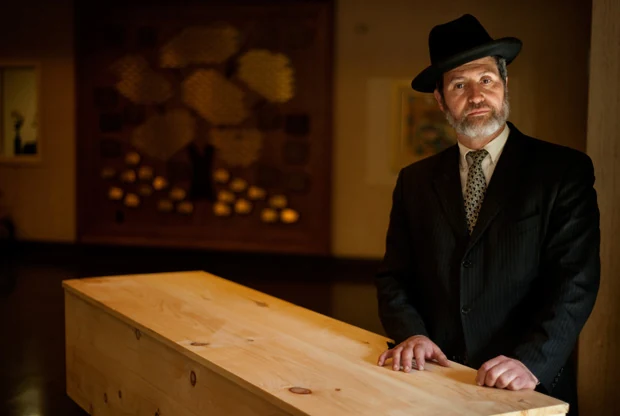
Jewish law calls for a simple casket, preferably a plain pine box with no metal. Holes are sometimes cut in the bottom to hasten the natural decomposition of the body. The plainness is intentional: in death everyone is treated equally, regardless of wealth or status.
Common questions about a Jewish funeral
A few questions come up again and again. Here are short, practical answers.
How long does a Jewish funeral last?
It depends on how well known the person was, how many people speak, and the family's wishes, but a Jewish funeral is rarely longer than one hour.
Is the funeral in Hebrew?
It is likely to be in both English and Hebrew. In some cases there is a book that translates the Hebrew into English. The exact balance depends on the denomination and the family's wishes.
Can Jews be cremated?
It usually depends on the sect of Judaism observed. Orthodox Judaism does not allow cremation, holding that the body should be buried intact. Reform Judaism has become more open to it, and Reform rabbis are usually willing to officiate at a funeral or burial. Conservative denominations remain opposed, though a rabbi may still officiate at the funeral for the ashes, but rarely at the burial. If your family is weighing this choice, our overview of the cremation process explains how it works step by step.
Can they be embalmed?
Unless required by law, embalming and cosmetic procedures are not allowed. The same applies to autopsies; where one is legally mandated, a rabbi may be present if possible.
Why are mirrors covered when someone dies?
This tradition comes from very old customs and superstitions, and there are many opinions about its significance. The most common explanation is that mourners should concentrate on God and on the soul of the departed rather than dwelling on their own vanity.
Jewish burial
After the service concludes, the casket is carried by hand to the burial site where possible, usually by family and close friends. Serving as a pallbearer is considered a great privilege.
Burial timing under Jewish law
Jewish law mandates that burial take place within 24 hours of death, though this is not always possible. Funerals are prohibited on the Sabbath, so a Saturday death may wait until Sunday. A burial may also be delayed when close relatives must travel from abroad, and is not allowed on some Jewish holidays.
Time-of-death rituals
After death the entire body is washed thoroughly in a ritual bath known as taharah, in which it is submerged in water or water is poured over it. The deceased is then dressed in white burial shrouds. If the person died with blood on their clothing from an injury, the washing is not completed; the belief is that a person's blood is as important as their life and should be buried with the body.
After-death rituals
From the moment of death until the funeral, the body is never left alone. A guardian called a shomer watches over it, frequently a member of the Chevra Kadisha. In some denominations, immediate family members tear their clothing to symbolize their loss.
Burial rituals
Those who will not attend the burial may escort the casket a short distance as it is carried to the gravesite. The pallbearers traditionally stop seven times along the way, symbolizing their reluctance to let go of their loved one. Visitors to a Jewish cemetery will often see stones placed on the grave markers. People give varying reasons: it tells later visitors that other mourners have been there, and for some it signifies that they are never finished building a monument for the departed.
At the graveside
At the gravesite, the mourners sit while other attendees stand around the grave. If the tearing of clothing has not already happened, the rabbi sometimes does it for them at that time. Someone chants from Psalms as the casket is lowered, and the rabbi recites, typically in Hebrew, a wish that the person go to their resting place in peace. The mourners then say the Mourner's Kaddish, which reaffirms their belief in God, and fill the grave with earth by passing a shovel from one person to the next.
Filling the grave
The shovel is used convex side up and is not handed directly from person to person; instead it is placed back into the dirt for the next mourner to lift. Some mourners take grass from the ground and throw it behind them, a gesture signifying their renewed awareness of their own mortality.
Is there a Jewish wake?
Because of the urgency to bury quickly, a wake or visitation is rare. Instead, the family gathers and tears their clothing in a visible place, such as a lapel or pocket, to show they are in mourning. This is sometimes done at the gravesite by the rabbi, or replaced with a torn piece of black material pinned to the clothing.
Mourning and bereavement customs
Jewish mourning unfolds in two main periods, giving the family structured time to grieve and a community around them to provide support.
What is shiva?
Shiva, meaning 'seven,' is the first period of mourning. It begins immediately after burial and lasts seven days. During shiva the family steps back from their normal daily routine, including going to work, and a candle burns for the full week. Friends and relatives visit to offer comfort and bring meals.
What is shloshim?
Shloshim, meaning 'thirty,' is the second period, beginning the first day after the funeral. The family resumes daily life but continues to recite the Mourner's Kaddish for 30 days. When mourning a parent, the Kaddish is traditionally said for a full year.
Funeral etiquette for guests
If you are attending a Jewish funeral and are unfamiliar with the customs, a few simple guidelines will help you take part respectfully. The best thing to remember is to dress conservatively.
What men should wear
Men should wear a jacket and tie along with a yarmulke, the traditional head covering.
What women should wear
Women should wear a skirt or dress with a length that reaches at least below the knee, with shoulders covered, and should avoid open-toe shoes. A head covering is typically not necessary for women.
What to say
You are not expected to speak during the service, which mainly consists of prayer. When you do talk with the bereaved, simply express your sympathy for their loss and perhaps say something kind about the person who died.
What not to say
As with any funeral, avoid asking about the cause of death, and steer clear of well-meaning lines like 'I know how you feel.' A quiet, genuine expression of condolence is enough.
What to bring
Flowers are not generally part of a Jewish funeral and should not be sent or brought. Because the family abstains from everyday duties such as cooking during mourning, bringing food is an excellent option. It is a good idea to ask about the types of food to bring; a basket of baked goods, dried fruit, chocolate and nuts is a thoughtful choice.
What to send if you cannot attend
Contributing to a charity in the person's memory is an excellent gesture, as is sending a condolence card. Remember that a Jewish funeral is a quiet, somber occasion. Because the family is in mourning and unable to do their normal chores, often the most useful thing you can offer is practical help, such as cleaning the home, preparing meals, or babysitting.
FAQ
Jewish funeral traditions: rituals, burial and mourning: common questions
- Can Jewish people be cremated?
- It usually depends on the denomination. Orthodox Judaism does not allow cremation and holds that the body should be buried intact. Reform Judaism has become more open to it, and Reform rabbis are usually willing to officiate at a funeral or burial. Conservative denominations generally remain opposed, though a rabbi may still officiate at the funeral itself.
- How quickly does a Jewish burial take place?
- Jewish law calls for burial within 24 hours of death wherever possible, because prompt burial is seen as a way of honoring the deceased. Funerals are not held on the Sabbath or some holidays, and a burial may be delayed when relatives must travel from abroad.
- What are shiva and shloshim?
- Shiva is the seven-day mourning period that begins immediately after burial, when the family steps back from daily routines. Shloshim is the 30-day period that follows, during which the family resumes normal life but continues reciting the Mourner's Kaddish. For a parent, the Kaddish is said for a full year.
- What should I wear to a Jewish funeral?
- Dress conservatively. Men usually wear a jacket, tie and a yarmulke. Women typically wear a skirt or dress that reaches below the knee with shoulders covered, and avoid open-toe shoes.
- Should I bring flowers to a Jewish funeral?
- No. Flowers are not generally part of Jewish funeral tradition. Bringing food after the burial is far more welcome, since the mourning family abstains from cooking. A donation to charity in the person's memory is also a thoughtful gesture.
- Why do mourners place stones on Jewish graves?
- Leaving a small stone on a grave marker tells later visitors that someone has come to remember the person. For many, it also reflects the idea that the work of honoring the departed is never truly finished.

About the author
Adam Binstock
Founder of Cremation Institute
Keep reading
Related guides
Planning a cremation?
See what a direct cremation should cost where you live, and compare trusted providers before you pay for extras you may not need.
Direct cremation costs →